

The effectiveness of a membrane technology is ultimately defined by what it can and cannot remove. To understand these capabilities, it is useful to first examine each membrane’s molecular weight cut-off (MWCO), or Dalton rating, which serves as a practical indicator of its rejection performance.
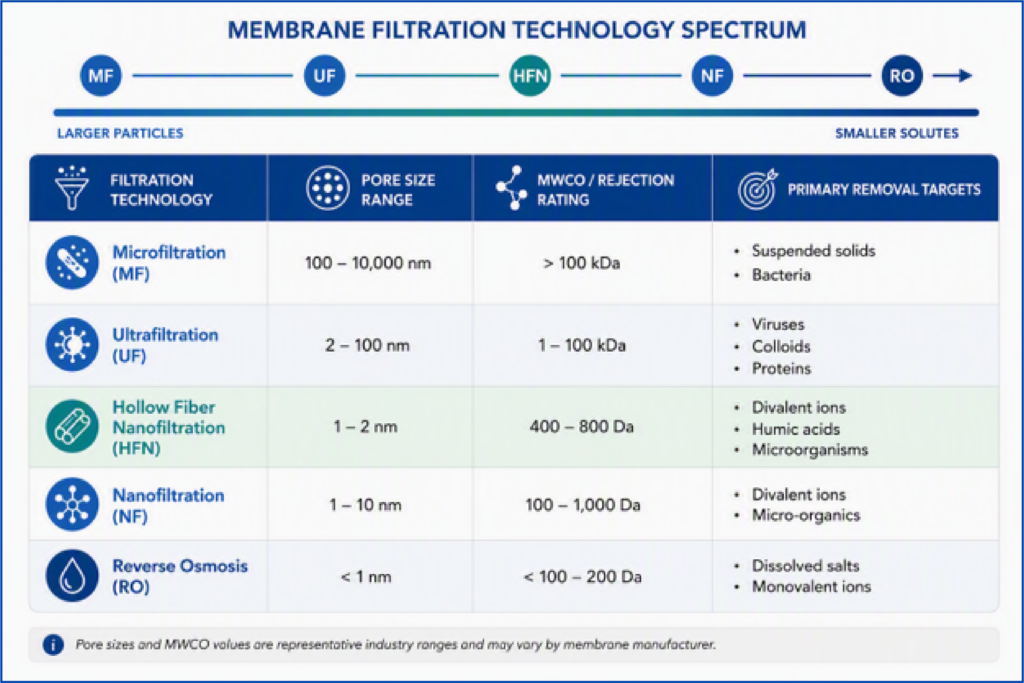
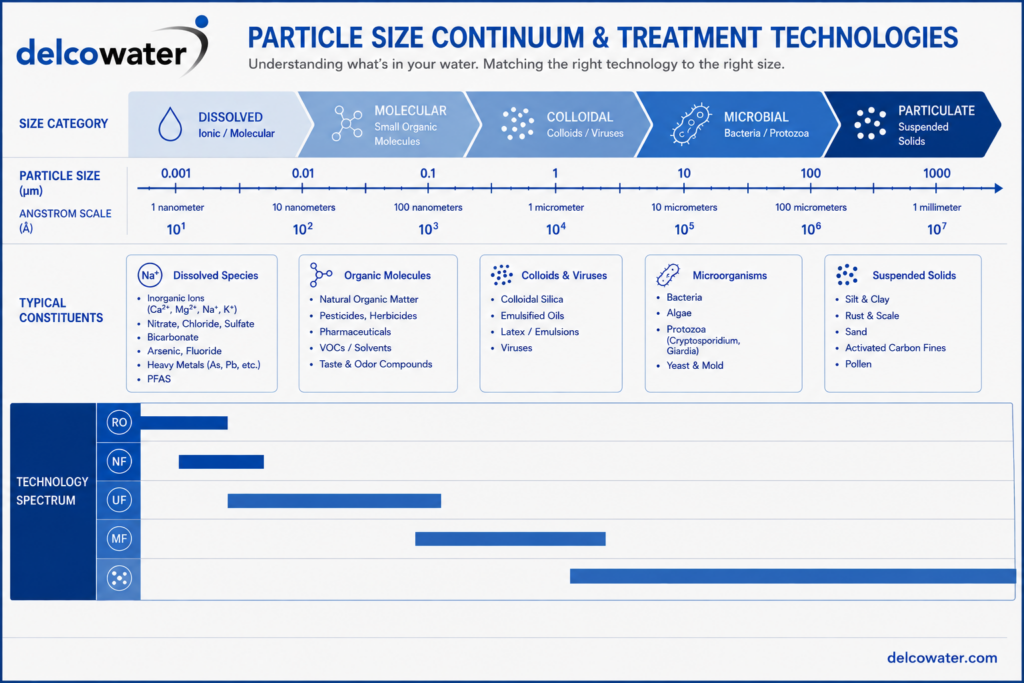
Ultrafiltration (UF) and microfiltration (MF) membranes are commonly characterized by molecular weight cut-off (MWCO) values ranging from approximately 1,000 to 500,000 Daltons (1-500 kDa). This range corresponds to contaminants spanning from small peptides and larger antibiotic compounds to high molecular weight organics, colloidal material, and viruses.
Nanofiltration (NF) membranes typically have MWCO values between 100 and 1,000 Daltons, targeting contaminants such as pesticides, dissolved organic compounds, and divalent ions responsible for hardness. Nanofiltration represents a broad spectrum of membrane performance, with rejection characteristics that overlap both ultrafiltration and reverse osmosis technologies. As a result, the classification of a membrane as “nanofiltration” can vary significantly depending on the manufacturer and membrane chemistry.
Hollow Fiber Nanofiltration (HFN) technology typically exhibits a molecular weight cut-off (MWCO) in the range of approximately 400 to 800 Daltons. This places HFN membranes at the more permeable, or “looser,” end of the nanofiltration spectrum, resulting in lower rejection of dissolved salts and hardness-causing ions relative to tighter nanofiltration and reverse osmosis membranes. Consequently, HFN performance is often evaluated based on its partial rejection of hardness and total dissolved solids (TDS), making it a relevant technology for comparison in the case study presented below.
Ultrafiltration (UF)
UF uses hollow fiber membranes to remove:
- Turbidity
- Suspended solids
- Pathogens
- Cryptosporidium and Giardia
UF is highly effective for particle removal and achieving regulatory log removal requirements, but it does not remove dissolved contaminants such as hardness, dissolved organic carbon (DOC), or total dissolved solids (TDS).
Reverse Osmosis and Nanofiltration (RO/NF)
RO and NF utilize spiral-wound membrane elements operating in crossflow mode. These technologies target:
- Dissolved organic compounds
- Salts and minerals
- Hardness
- Color
- Dissolved contaminants
RO/NF are highly effective at removing dissolved constituents within a water source.
Hollow Fiber Nanofiltration (HFN)
HFN combines characteristics of both UF and NF into a single membrane process. This is a hollow fiber membrane technology manufactured from polyether sulfone (PES) giving it a surface charge capable of rejecting dissolved organic carbon (DOC).
- Turbidity
- Suspended solids
- DOC
- Color
- Pathogens
- Cryptosporidium and Giardia
This technology is a hybrid of UF and RO/NF systems in that it is a hollow fiber membrane but delivers partial removal of dissolved ions through charge-based separation mechanisms and operates in crossflow filtration. This unique capability allows HFN to address both particulate and organic contaminants within a single treatment stage.
The ideal application for HFN is for source waters with characteristics of high organics, elevated color, moderate turbidity, low hardness and low TDS. However, it is not a universal replacement for all UF/RO applications. Source waters that require rejection of general TDS, or concerns such as hardness may still require traditional RO technology.
Real-World Performance: Case Study
To evaluate performance, two operating facilities with similar cold surface water sources and comparable treatment capacities were analyzed:
- Site A: UF + NF system (9.1 L/s)
- Site B: Hollow Fiber Nanofiltration system (9.3 L/s)
a) Dissolved Organic Carbon and Color
One of the most notable findings was the ability of both systems to remove DOC and color. HFN achieved DOC removal exceeding modeled projections and performed comparably to the UF/NF system in reducing organic loading.
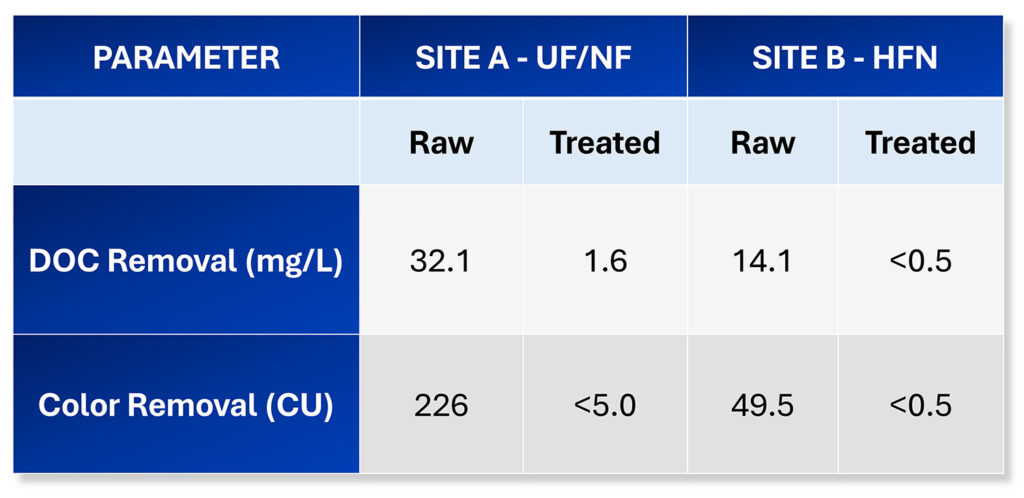
The primary reason why DOC treatment is important for surface water source waters owes to the fact that treated water is chlorinated before distribution to the public. It is a common requirement to maintain free chlorine in distribution systems for potable water for public safety. However, when free chlorine interacts with DOC a number of byproducts can be formed. The two primary byproducts concerned with drinking water are trihalomethanes (THM) and Haloacetic acid (HAA). A common way to address the formation of these byproducts is to treat the DOC before it is distributed to the public.
b) Turbidity and Pathogen Barrier
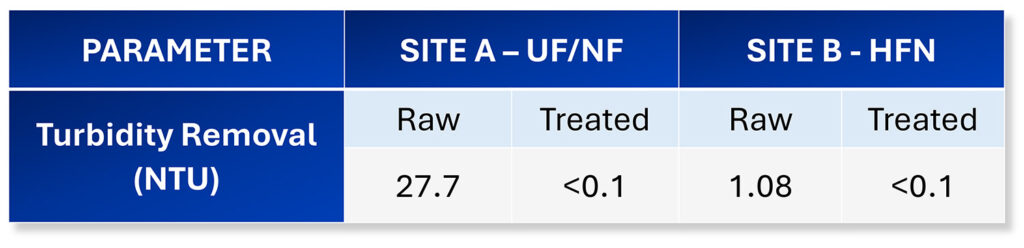
Turbidity removal between both technologies, UF/NF and HFN is equal in comparison. Both technologies provide substantial turbidity reduction while maintaining the ability to achieve membrane integrity verification and log removal requirements important for surface water treatment.
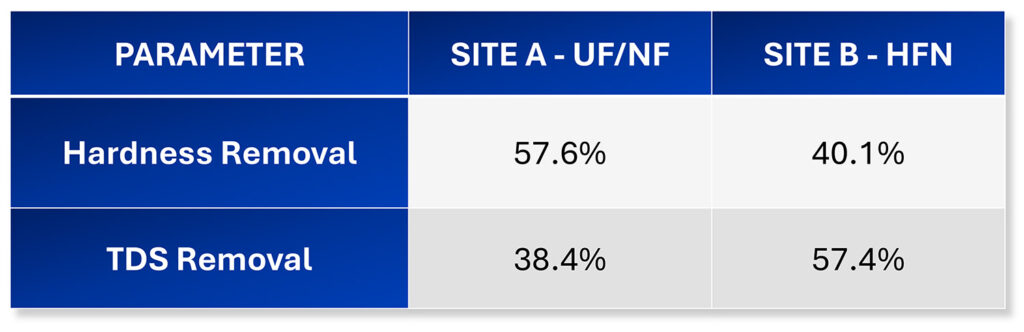
c) Hardness and Total Dissolved Solids
The comparison between hardness and total dissolved solids, highlights an important design consideration: HFN performs best when extensive mineral removal is not the primary treatment objective. Applications dealing with high hardness or elevated salinity may still require traditional RO technology.
Membrane recovery often has a direct impact on operating costs and water usage.
This case study shows:
- UF recovery greater than 90%
- NF recovery approximately 90%
- Combined UF/NF net recovery approximately 81%
- HFN net recovery approximately 76%
While HFN’s recovery appears slightly lower, in certain applications, regulators may approve the concentrate stream be returned to the raw water source due to no online chemicals required during operation. The waste stream is only a concentrated version of the raw water source. This creates operational advantages not always captured in simple recovery calculations.
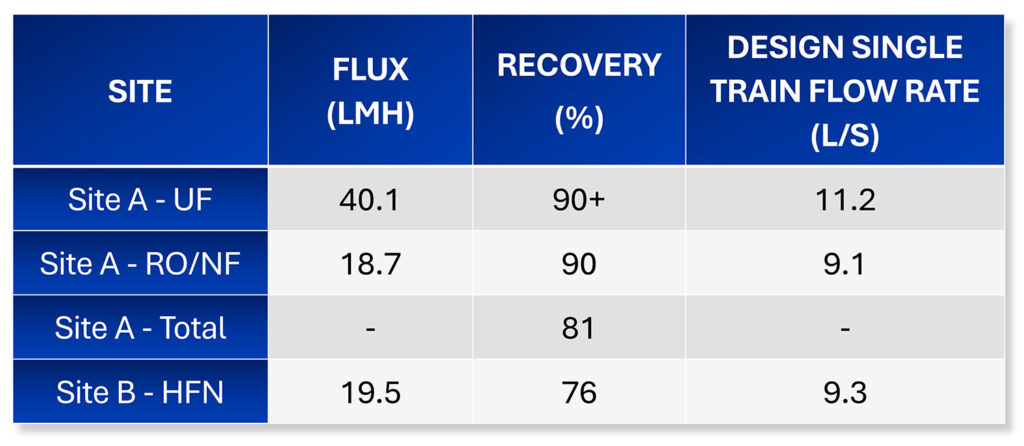
Although the HFN technology is a hollow fiber membrane, it operates in cross-flow filtration. This means there is an online waste stream and an online filtrate stream and recoveries are typically between 70-90%. HFN are designed more similarly to an RO in terms of flux as well. The flux is much more similar to the RO/NF vs. UF membrane due to its operation of cross-flow filtration and the importance of DOC removal.
One of the most significant advantages of HFN is system simplicity. A conventional UF/NF system typically requires:
- Two different membrane processes (UF and RO/NF)
- Interstage transfer pumps
- Break tanks
- CIP systems
- Compressor systems
- Additional instrumentation and controls
HFN eliminates many of these components by combining treatment objectives into a single process train. The result can include:
- Smaller plant footprints
- Reduced process complexity
- Lower operator involvement
- Simplified maintenance programs
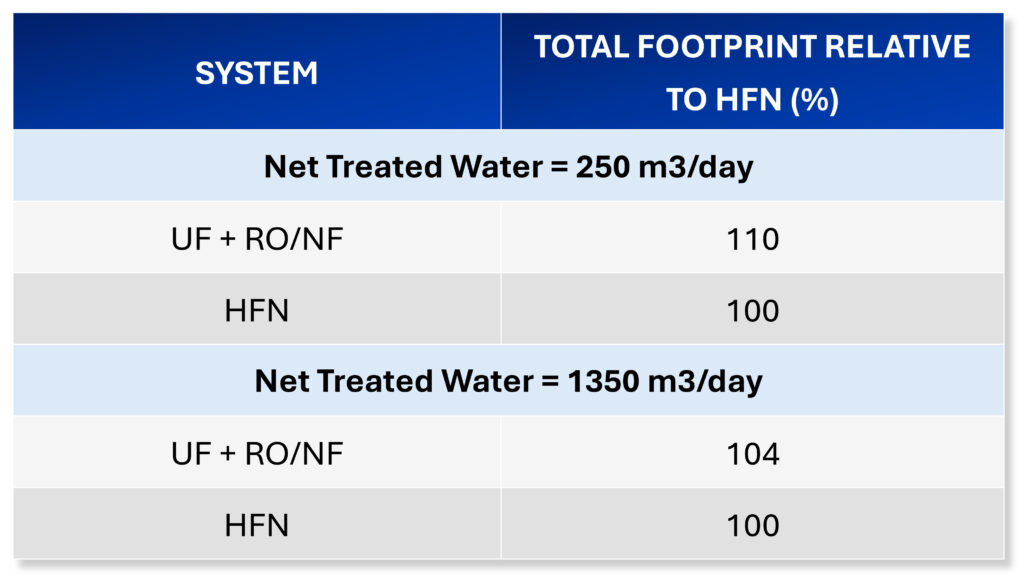
An important observation on system footprint and system capacity needs to be noted in addition to the above. The chart below shows as the system capacity increases, the footprint relative to the UF+RO/NF technology decreases and space saving becomes much narrower in comparison. This can be related back to the flux of the system. HFN is designed much closer to an RO/NF membrane and thus requires more HFN membranes for larger systems. The relative footprint benefit diminishes as system capacity increases.
Compared to conventional UF+RO/NF systems, HFN offers:
- No continuous antiscalant or other online chemical addition
- Fewer chemical cleanings
- Less frequent CIP requirements
- Reduced chemical handling and storage
Current HFN installations have demonstrated long cleaning intervals with significantly lower operator intervention requirements than conventional membrane systems.
This case study also compared relative costs for capital equipment and the operating and maintenance costs.
For smaller facilities around 250 m³/day, HFN demonstrated a capital cost advantage. As plant capacity increases, the number of required HFN modules grows, and capital costs can become more comparable to UF+RO/NF installations. These costs can vary as membrane technology matures and scale impacts individual membrane or module costs.
However, operating and maintenance costs strongly favored HFN in both small and larger treatment capacities.
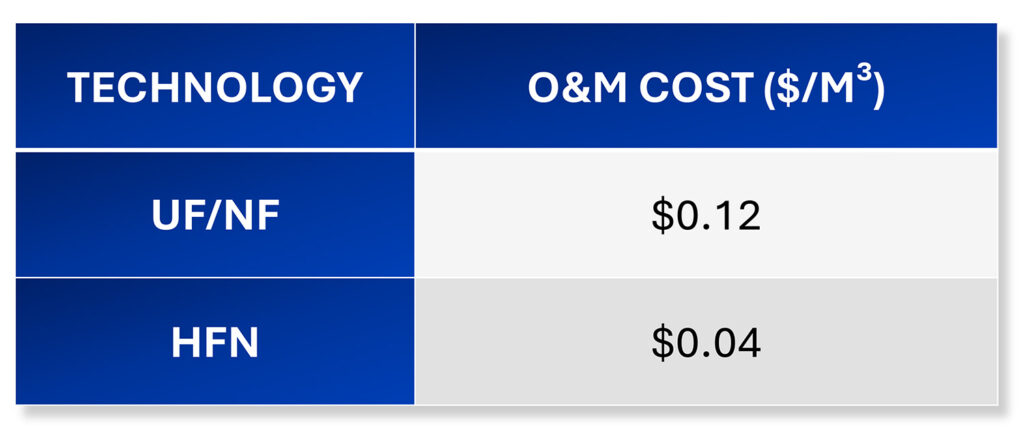
The reduction in chemical consumption, operator involvement, and cleaning frequency contributed to significantly lower operational expenses for HFN technology. These benefits can be particularly important for remote and northern communities where operator resources are limited. The difference in O&M costs effectively consist of the RO/NF booster pump and online antiscalant chemical being required for the spiral wound membrane process.
The comparison between ultrafiltration plus spiral wound membranes and hollow fiber nanofiltration demonstrates that there is no universal “best” membrane technology, only the best technology for a given water source and treatment objective. For source waters characterized by elevated organics, color, and turbidity but relatively low hardness and TDS, HFN offers a compelling alternative by combining particle removal, DOC reduction, and pathogen protection into a single treatment process.
Real-world performance data from the discussed case study demonstrates that while conventional UF/NF systems remain advantageous where higher mineral rejection is required and may offer capital benefits at larger treatment capacities, HFN can significantly reduce process complexity, chemical consumption, operator involvement, and operating costs all without sacrificing efficiency and recovery rates and water quality targets. HFN represents an innovative and alternative option to UF+RO/NF systems that can simplify plant design and improve lifecycle economics when applied to the appropriate source water conditions.